
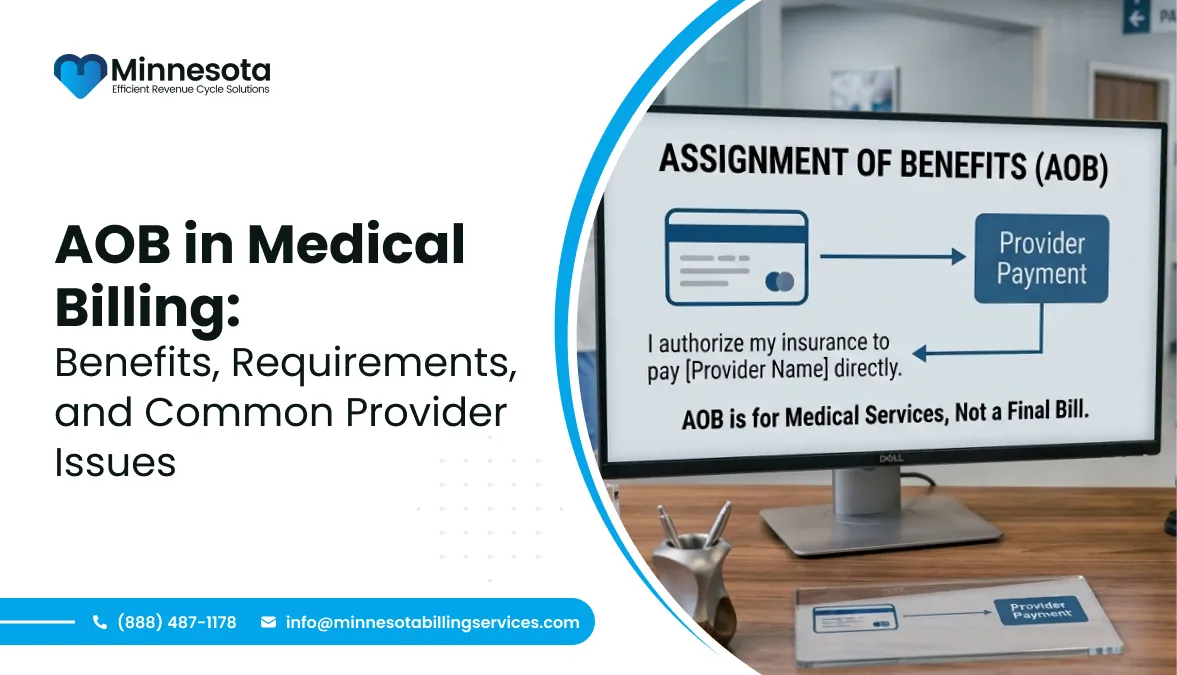
Assignment of Benefits (AOB) is an important part of the medical billing process because it determines how insurance payments are directed after a healthcare provider delivers services. For physicians, medical practices, hospitals, and other healthcare providers, a properly completed AOB can help streamline insurance claims and reduce payment-related confusion.
However, AOB problems can lead to trouble when the patient’s insurance and personal details, signatures and payer needs are incomplete. Providers might have claims rejected and take longer to be paid, have their payments challenged or undertake extra paper work.
Understanding AOB in medical billing helps providers establish a more reliable billing workflow. It also helps billing teams coordinate insurance verification, claim submission, payment posting, and accounts receivable follow-up more effectively.
What Is AOB in Medical Billing?
AOB, or Assignment of Benefits, is a signed statement by the patient that would authorize an insurance company to make insurance payments to the provider rather than making the payments to the patient.
When a patient signs an assignment of benefits agreement, the provider can generally submit claims to the patient’s insurance company and receive applicable payments directly from the payer.
For Medicare claims, providers should also understand the rules related to accepting assignment, which can affect how Medicare pays providers and how patient costs are handled.
For example, suppose a patient receives medical services from a physician and has active health insurance. The provider submits a claim to the patient’s insurance company. If the patient has properly assigned benefits to the provider, the insurer can send the eligible payment to the provider according to the patient’s plan and applicable payer rules.
Benefits are not a guaranteed payment. The invoice is due by the payer and must be provided on time, and the type of procedure, coverage, whether the patient qualifies, and other rules must be followed.
How Does Assignment of Benefits Work?
The AOB billing process generally begins when the patient provides insurance information and completes the required registration documents.
A simplified workflow looks like this:
- The patient provides insurance information.
- The provider or billing team verifies insurance eligibility and benefits.
- The patient reviews and signs the applicable AOB authorization.
- The provider delivers healthcare services.
- The billing team codes the encounter and prepares the claim.
- The claim is submitted to the insurance payer.
- The payer adjudicates the claim.
- The insurance company sends the eligible payment to the provider when assignment requirements are satisfied.
- The provider posts the payment and applies the appropriate contractual adjustments.
- Any remaining patient responsibility is billed according to applicable requirements.
This process connects AOB in healthcare with several other revenue cycle activities. A missing or incorrect AOB can therefore create problems beyond the initial claim submission.
AOB BILLING WORKFLOW
From Patient Registration to Insurance Payment
Assignment of Benefits connects several stages of the medical billing and payment process.
1. Registration
Patient provides insurance information.
2. Verification
Eligibility and benefits are reviewed.
3. AOB Authorization
Patient completes the applicable authorization.
4. Service
Healthcare services are provided.
5. Claim
The coded claim is submitted to the payer.
6. Adjudication
The payer processes and evaluates the claim.
7. Payment
Eligible payment is directed according to applicable requirements.
8. Payment Posting
Payment and applicable adjustments are recorded.
Why Is AOB Important for Healthcare Providers?
A properly managed provider assignment of benefits can make the payment process more efficient.
Direct Insurance Payments
One of the primary benefits of an AOB is that it allows eligible insurance payments to be directed to the provider. This can simplify payment collection because the practice does not have to rely entirely on the patient receiving an insurance payment and then paying the provider.
More Efficient Claims Processing
A clear AOB arrangement can support a smoother claims workflow. When patient registration, insurance information, and assignment documentation are complete, billing teams have fewer administrative issues to resolve.
Reduced Payment Confusion
AOB can help clarify who should receive applicable insurance payments. This can reduce confusion between patients, providers, and insurance companies.
Better Revenue Cycle Management
AOB is only one part of the overall revenue cycle. Providers also need accurate coding, insurance verification, timely claim submission, payment posting, denial follow-up, and accounts receivable management.
Practices looking for ways to improve the complete billing process can consider revenue cycle management services to coordinate these activities.
AOB Requirements in Medical Billing
AOB requirements can vary by payer, plan, provider type, and situation. Providers should therefore avoid assuming that one AOB form will satisfy every insurance company’s requirements.
Common information included in an AOB form in medical billing may include:
- Patient’s name
- Patient identification information
- Insurance information
- Provider or practice information
- Authorization for assignment of benefits
- Patient signature
- Date of signature
- Applicable provider information
- Other information required by the payer or practice
The practice should maintain appropriate documentation according to its policies and applicable payer requirements.
Patient Signature and Authorization
The patient’s authorization is an important part of an assignment of benefits form. Providers should make sure the patient understands the relevant authorization documents and that the required signature is properly captured.
A missing signature or incomplete form can create administrative problems when the payer processes the claim.
Accurate Insurance Information
An AOB cannot compensate for incorrect insurance information. Providers should verify the patient’s payer, member ID, group information, coverage status, and other relevant details before submitting claims.
This is why insurance benefits verification services can be valuable for practices with high claim volumes or complex payer requirements.
Current Documentation
Providers should maintain current documentation and review their registration and billing workflows periodically. Payer requirements can change, and practices should update their processes when necessary.
AOB vs. EOB: What Is the Difference?
Assignment of Benefits and EOB are often confused because both relate to insurance payments, but they serve different purposes.
AOB means Assignment of Benefits. It is an authorization that allows applicable insurance benefits to be assigned to the provider.
EOB means Explanation of Benefits. It is a document from the insurance company explaining how a claim was processed.
An EOB may show:
- Amount billed
- Allowed amount
- Insurance payment
- Contractual adjustment
- Deductible
- Coinsurance
- Copayment
- Patient responsibility
- Claim processing information
An AOB indicates the location of the patient’s insurance benefit(s) where payment should be made, whereas an EOB details how the insurance payer processed the claim.
Providers need to train their billing staff so they understand this difference because mistakenly submitting an AOB as an EOB can lead to both extra patient communications and extra payment-posting issues.
KNOW THE DIFFERENCE
AOB vs. EOB
Both relate to insurance claims, but they serve different purposes.
AUTHORIZATION
AOB
Assignment of Benefits authorizes applicable insurance benefits to be assigned to the healthcare provider.
Main purpose
Helps direct eligible insurance payments to the provider.
CLAIM EXPLANATION
EOB
Explanation of Benefits explains how an insurance payer processed a submitted claim.
Main purpose
Shows billed amounts, allowed amounts, payments, adjustments, and patient responsibility.
Common AOB Issues Providers Face
Even when a practice uses an AOB form, several issues can affect claim processing and reimbursement.
Missing AOB Form
A missing AOB authorization can create payment-related issues if the payer requires assignment documentation before directing benefits to the provider.
Incomplete Patient Information
Incorrect patient demographics or insurance information can result in claim rejections and delays.
Incorrect Insurance Payer
Patients may change insurance plans without informing the provider. Submitting a claim to the wrong payer can delay reimbursement.
Invalid or Missing Signature
An AOB form may not meet the applicable requirements if the necessary patient authorization or signature is missing.
Outdated Forms
A practice that continues using outdated forms may encounter problems when payer requirements change.
Coordination of Benefits Problems
Patients with multiple insurance plans may require additional coordination. The billing team must determine the applicable primary and secondary insurance before processing the claim.
Payment Sent to the Patient
In some situations, the payer may send payment to the patient instead of the provider. The practice may then need to contact the patient or pa
AOB RISK AREAS
Common AOB Issues Providers Face
Small registration and documentation issues can create larger payment problems.
Missing AOB Form
Required assignment documentation may be missing when the claim is processed.
Incomplete Information
Incorrect demographics or insurance details can cause claim delays.
Incorrect Payer
A claim submitted to the wrong insurance payer may delay reimbursement.
Missing Signature
An incomplete authorization may not satisfy applicable payer requirements.
COB Problems
Multiple insurance plans can create primary and secondary coverage issues.
Payment Sent to Patient
The practice may need additional follow-up when payment is not directed as expected.
yer to resolve the payment issue.
How AOB Problems Can Affect Medical Claims
An AOB issue can become a larger billing problem when it delays or prevents appropriate insurance payment.
For example, if a practice submits a claim without required assignment documentation, the payer may request additional information or process payment differently than expected.
Other claim issues can occur at the same time, such as:
- Insurance eligibility errors
- Incorrect patient information
- Coding errors
- Missing documentation
- Incorrect payer information
- Claim submission errors
- Authorization issues
- Coordination of benefits problems
This is why AOB should not be treated as an isolated administrative form. It should be incorporated into the practice’s overall medical billing services workflow.
How Providers Can Prevent AOB-Related Billing Problems
Providers can take several practical steps to reduce AOB-related issues.
Collect AOB Information During Registration
The front desk or registration team should collect required insurance and authorization information before services are rendered whenever possible.
Verify Insurance Eligibility
Insurance verification can identify whether the patient’s coverage is active and help the practice confirm important benefit information.
Review AOB Documentation
Billing staff should confirm that the required AOB documentation is complete before submitting claims.
Keep Patient Records Updated
Patients may change insurance plans, addresses, employers, or other information. Practices should update demographic and insurance information regularly.
Monitor Payer Requirements
Different insurance companies can have different requirements. Billing teams should follow applicable payer instructions rather than using a one-size-fits-all process.
Track Payment Problems
If AOB-related payment problems occur repeatedly, management should identify the source of the issue and improve the registration or billing workflow.
Prevent AOB-Related Billing Problems
Build AOB checks into the billing workflow instead of waiting for payment problems to occur.
BEFORE SERVICE
Prepare
DURING BILLING
Review
AFTER SUBMISSION
Monitor
AOB and Insurance Verification
AOB insurance issues are closely connected with insurance verification.
Before submitting a claim, the billing team should verify important information such as:
- Active coverage
- Member identification number
- Group number
- Effective dates
- Copayment
- Deductible
- Coinsurance
- Benefit limitations
- Primary and secondary coverage
- Payer-specific requirements
Verification does not replace the AOB. Instead, both processes work together to support accurate claim submission and payment processing.
For providers that want to strengthen front-end revenue cycle processes, insurance eligibility verification can help identify coverage problems before claims are submitted.
AOB and Medical Billing Services
AOB management is one component of a larger billing workflow. Providers still need accurate coding, claim submission, payment posting, denial follow-up, and accounts receivable management.
A professional medical billing company can help practices coordinate these processes and identify problems that affect reimbursement.
Medical billing services in Minnesota offers billing assistance such as medical billing, coding, insurance benefits verification, credentialing, denial management, and accounts receivable follow-up services.
Outsource Your Billing Tasks to Minnesota Billing Services For practices interested in outsourcing their billing tasks, Minnesota medical billing services can help handle some of the office work and enable you and your clinical staff to dedicate more time to patient care.
AOB Issues and Claim Denial Management
AOB problems can sometimes contribute to delayed or disputed payments. However, providers should examine the complete claim before assuming that AOB was the only cause.
A denial management workflow can identify:
- AOB-related issues
- Eligibility problems
- Coding errors
- Documentation gaps
- Authorization problems
- Medical necessity issues
- Incorrect payer information
- Timely filing problems
When the denial reason has been determined, your billing staff can determine whether the claim is in need of correction, rebilling, appeal, or other appropriate payer response.
If you are a provider with frequent recurring claim issues, denial management services that helps identify the problem and simplifies claim resolution may be beneficial.
AOB and Accounts Receivable Management
When insurance payments are delayed, outstanding balances can accumulate in accounts receivable.
A strong A/R follow-up and management process helps providers monitor unpaid claims and determine why payments have not been received.
The billing team can review:
- Claim submission status
- Payer response
- AOB-related information
- EOB details
- Payment posting
- Denial or rejection information
- Appeal status
- Outstanding balance
Effective A/R management is especially important for practices with high claim volumes because small payment delays can become significant revenue problems over time.
AOB for Different Medical Specialties
Assignment of Benefits requirements and billing workflows can affect nearly every healthcare specialty that submits claims to insurance companies.
AOB in Family Medicine
Accurate registration, proper billing, verification, AOB, coding, and claims submission are crucial to ensure your billing process goes without any bumps.
Family medicine billing services providers may look for specialty billing services if they are left with nothing else to try.
AOB in Cardiology
Cardiology practices often manage complex services, procedures, and payer requirements. Accurate patient information and assignment documentation should be incorporated into the overall billing process.
Specialized cardiology billing support can help practices manage coding, claims, payment posting, and payer follow-up.
AOB in Internal Medicine
Internal medicine practices may manage patients with multiple conditions and multiple insurance arrangements. Proper insurance verification and AOB documentation can help reduce administrative problems.
AOB in Pediatrics
Pediatric practices may deal with insurance information involving parents, guardians, and dependents. Billing teams should carefully verify the responsible party and insurance information before submitting claims.
AOB in Surgery
Surgical practices can face complex claims involving procedures, authorizations, multiple providers, and payer requirements. AOB documentation should be part of a broader pre-service and billing workflow.
Minnesota Billing Services currently lists specialties including family medicine, cardiology, internal medicine, pediatrics, surgery, radiology, oncology, OB/GYN, urgent care, and others.
Common Provider Mistakes With AOB
Providers can reduce AOB-related problems by avoiding several common mistakes.
Failing to collect the required authorization: Missing documentation can create payment problems.
Assuming every payer has the same requirements: Insurance companies can have different processes and requirements.
Ignoring insurance changes: Patients may have new insurance coverage that is not reflected in the practice management system.
Failing to verify eligibility: A signed AOB does not mean that coverage is active.
Not monitoring unpaid claims: Payment issues can be left unresolved if there’s not a proper follow-up process in place.
Treating AOB as a standalone process: it’s integrated with registration, eligibility verification, coding, claims, payment posting, and A/R management.
AOB and Revenue Cycle Management
AOB is part of the broader healthcare revenue cycle management process. Providers should also understand provider assignment requirements when working with Medicare claims and payment arrangements
The revenue cycle begins before the patient encounter and continues until the provider receives payment and resolves any outstanding balance.
A typical workflow includes:
- Patient registration
- Insurance verification
- AOB collection
- Charge capture
- Medical coding
- Claim creation
- Claim submission
- Insurance adjudication
- Payment posting
- Denial management
- A/R follow-up
- Patient billing
When each stage works together, providers can identify billing problems earlier and reduce unnecessary administrative work.
For practices reviewing their overall billing workflow, revenue cycle management services can help coordinate these financial processes.
How Outsourcing AOB-Related Billing Can Help Providers
Managing AOB documentation, insurance verification, claims, denials, and A/R internally can require significant staff time.
Outsourcing some or all billing functions may help providers when they experience:
- High claim volumes
- Frequent payment delays
- Staff shortages
- Increasing denials
- Difficult payer requirements
- Slow A/R follow-up
- Inconsistent insurance verification
- Billing backlogs
An outsourced medical billing and coding services team can support the administrative side of the revenue cycle while practice staff focus on clinical operations.
The right billing partner should provide transparent reporting and clear communication about claims, payments, denials, and outstanding accounts.
Best Practices for Managing AOB in Medical Billing
Providers can strengthen their AOB process by following these best practices:
- Collect accurate patient and insurance information.
- Obtain the appropriate AOB authorization.
- Verify insurance eligibility before services whenever possible.
- Review payer-specific requirements.
- Keep patient records updated.
- Confirm primary and secondary insurance when applicable.
- Train registration and billing staff.
- Review rejected and denied claims.
- Monitor A/R aging.
- Track recurring AOB-related problems.
- Audit billing workflows regularly.
- Maintain appropriate documentation.
These steps can help create a more consistent relationship between patient registration, insurance verification, claim submission, and reimbursement.
When Should Providers Consider Outsourcing Medical Billing?
Providers should consider outsourcing when billing activities begin taking too much time away from practice operations or when unresolved claims are affecting cash flow.
Signs that a practice may benefit from professional billing support include:
- Increasing claim denials
- Growing A/R balances
- Delayed insurance payments
- Limited billing staff
- Frequent eligibility errors
- Coding problems
- Difficulty keeping up with payer requirements
- Inconsistent claim follow-up
- Administrative overload
A professional billing company can provide access to specialized billing, coding, insurance verification, denial management, and A/R expertise.
Providers can also compare medical billing pricing structures when evaluating whether outsourcing makes financial sense for their practice. Minnesota Billing Services has published a detailed guide covering percentage, flat-fee, monthly, and hybrid billing models.
Conclusion
AOB in medical billing plays an important role in how healthcare providers receive insurance payments. Assignment of Benefits allows applicable insurance benefits to be assigned to the provider, but it does not eliminate the need for accurate eligibility verification, coding, documentation, claim submission, and follow-up.
Providers should collect appropriate AOB documentation, verify insurance information, monitor payer requirements, and address payment problems quickly. A strong process can reduce administrative issues and support a more efficient revenue cycle.
For Minnesota healthcare providers, professional medical billing services can reduce the time and resources spent handling insurance verification, coding, claims, denial follow-up, payment posting, and accounts receivable. Providers who have a coordinated billing process can devote less time to administrative concerns and focus more on their patients.
Frequently Asked Questions About AOB in Medical Billing
What is AOB in medical billing?
AOB (Assignment of Benefits) is an authorization that allows a patient’s insurance company to send eligible payments directly to the healthcare provider instead of the patient.
Why is an AOB form important for healthcare providers?
An AOB form helps authorize direct insurance payments to the provider and can support a smoother claims and reimbursement process. Providers should ensure the required information and patient authorization are complete.
What information should an AOB form include?
An AOB form typically includes the patient’s information, insurance details, provider information, authorization for assignment of benefits, patient signature, and date. Requirements may vary by payer.
Can AOB issues cause medical claim payment delays?
Yes. Missing or incomplete AOB documentation can contribute to payment delays or other claim-processing issues. Providers should also verify eligibility, patient information, coding, and payer requirements.
What should providers do if an insurance company does not pay them directly?
Providers should review the claim, AOB documentation, payer requirements, and explanation of benefits to determine why payment was not directed to the practice. The billing team can then contact the payer or take appropriate follow-up action.