
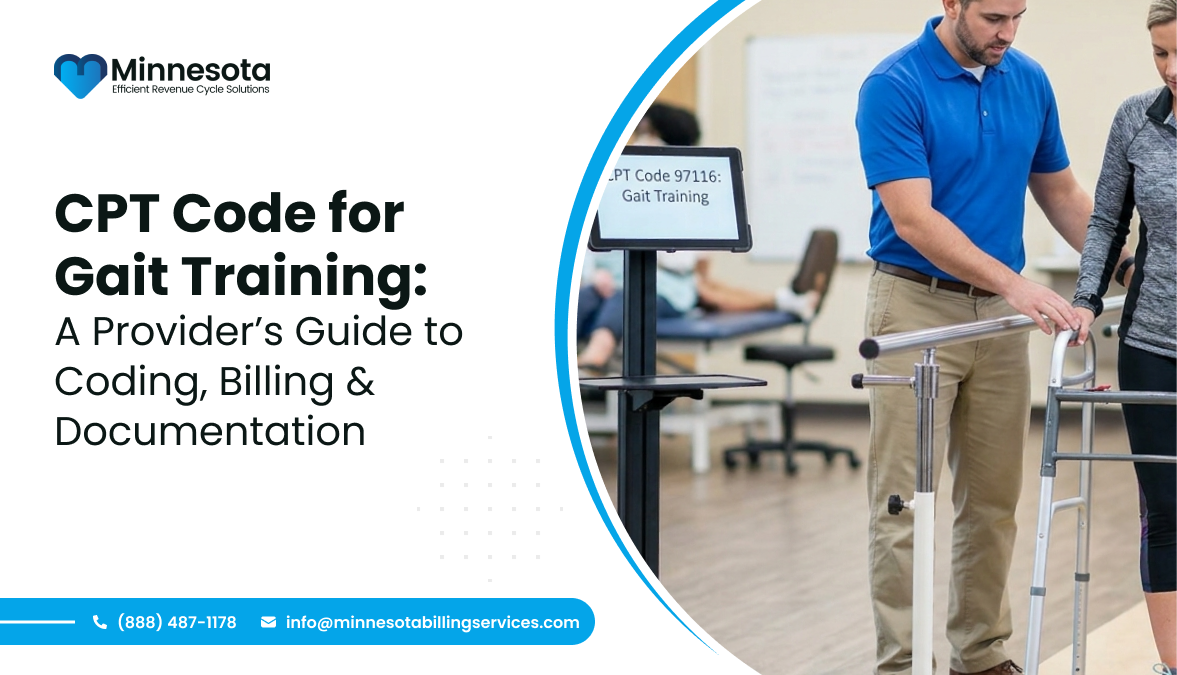
Gait training is an important part of physical therapy for patients who have difficulty walking safely, maintaining balance while moving, or using an assistive device correctly. For providers, however, treating a gait impairment is only one part of the process. The treatment must also be documented and reported correctly so the claim accurately reflects the service performed.
CPT code for gait training is a category of treatment that is designed to assist patients in gaining more mobility as it relates to walking and other related movements. Gait training coding will require the doctor and biller to have an understanding of gait training, how to apply treatment time to units, medical necessity documentation, and what separates gait training from other therapies.
By understanding these rules, you will be able to do away with coding anomalies, billing delays and stress over the reimbursement for physical therapy coders and providers.
What Is the CPT Code for Gait Training?
The primary gait training CPT code is 97116.
97116 Gait training (includes stair climbing) is a therapy performed on one or more areas. 15 minutes. CMS recognizes 97116 as a timed therapy.
Gait training is indicated when there is a need for the patient to undergo a trained intervention to improve gait pattern, general mobility and walking safety. Based on the patient’s condition and treatment plan, the treatment may be:
- Walking pattern and coordination
- Step length and foot placement
- Weight shifting during ambulation
- Balance during walking
- Use of a walker, cane, crutches, or other assistive device
- Stair negotiation
- Safe transitions during functional mobility
- Adaptation to changes in walking surfaces or environments
The clinical note should explain what the provider actually performed rather than simply stating that gait training occurred.
When Is Gait Training Appropriate?
Gait training is usually reported for patients with confirmed pathology involving a walking or functional mobility impairment. The specific pathology can be quite variable.
Other examples are individuals recovering from neurological disease, injury, or surgery; lower-extremity weakness; balance deficits; or other conditions that may impair safe ambulation.
The main point for documenting gait training is to connect the professional intervention delivered to the patient’s functional restriction.
For example, there could be a note that a patient requires verbal and tactile cues to increase foot clearance while walking with a walker. Another patient may require skillful stair training because weakness and balance problems make stair climbing unsafe.
The documentation should support why the intervention needed to be provided by the treating professional and how the provided treatment connects to the patient’s plan of care.
What Does CPT 97116 Include?
CPT 97116 is specifically associated with gait training and includes stair climbing.
Depending on the patient’s needs, a session may involve:
Walking With Assistive Devices
The therapist might teach the patient how to ambulate with a cane, walker, crutches, or other device that is appropriate to keep proper gait mechanics.
When necessary, describe the device within the documentation, and demonstrate training has been afforded. Simply recording “walked with walker” may not adequately explain the skilled component of the service.
Stair Training
CPT 97116 will have stair climbing that is part of the billed service so if a motion therapist does a gait training session, they can code this if it is determined that the motion therapist is trying to improve the patient’s ability to do stairs.
The record should reflect the activity performed, patient limits, amount of support/cues, and patient response.
Functional Ambulation Training
Besides strength, gait training can also focus on walking mechanics and functional mobility. This includes working with a therapist on speed, step pattern, balance, weight shifting, foot clearance, or functional safe progression of movement.
The note should incorporate these interventions into the patient’s stated impairment and goals.
CPT 97116 Units and the 8-Minute Rule
CPT 97116 Time and Units
One of the most important gait training billing guidelines involves treatment time.
CPT 97116 is a timed code that is billed in 15-minute units. When billing for outpatient therapy with Medicare, CMS considers overall timed treatment minutes for units. For all services, anything less than 8 minutes usually is not billed as a timed unit, and the appropriate time for other units is based on the ranges.
A simplified Medicare timed-service framework is:
| Total Timed Treatment Minutes | Maximum Units |
| 8–22 minutes | 1 |
| 23–37 minutes | 2 |
| 38–52 minutes | 3 |
| 53–67 minutes | 4 |
| 68–82 minutes | 5 |
| 83–97 minutes | 6 |
| 98–112 minutes | 7 |
| 113–127 minutes | 8 |
CPT 97116 Unit Calculation Example
For example, suppose a therapist documents:
- 20 minutes of gait training
- 18 minutes of therapeutic exercise
- 10 minutes of manual therapy
The total timed treatment is 48 minutes. The total number of billable timed units is therefore constrained by the combined treatment time rather than simply assigning a separate unit to every procedure.
Think in Total Treatment Minutes
When multiple timed therapy procedures are reported, review the combined treatment time before assigning units.
If gait training, therapeutic exercise, and manual therapy are all timed services on the same date, evaluate the combined treatment minutes rather than treating every procedure as an automatically separate unit calculation.
Payer policies can differ, so providers should verify the applicable requirements before submitting claims. For Medicare-specific therapy billing requirements and current updates, providers can review the CMS Therapy Services guidance.
What Should Gait Training Documentation Include?
Strong gait training documentation should make the treatment understandable to another qualified professional reviewing the record.
CMS guidance for outpatient therapy emphasizes documentation such as gait distance, assistive device used, level of assistance, gait limitations, cueing, techniques performed, and the patient’s response.
Build the Note Around the Treatment
A useful gait-training note should connect the patient’s limitation, the skilled intervention, measurable treatment details, and the patient’s response.
Strong documentation connects the clinical problem → skilled treatment → measurable details → patient response.
Important elements may include:
Patient’s Functional Limitation
Document the walking or mobility problem being treated. Examples may include impaired balance, abnormal gait, reduced foot clearance, difficulty with stairs, or inability to safely use an assistive device.
Skilled Intervention
Describe what the therapist did. Instead of writing “gait training performed,” identify the intervention, such as training with a walker, stair negotiation, cueing for foot placement, or correction of gait mechanics.
Assistance and Cueing
When applicable, record the level and type of assistance provided. Verbal, visual, or tactile cues can help demonstrate the skilled nature of the intervention when they are clinically relevant.
Distance or Functional Task
Include meaningful treatment details such as walking distance, number of stairs, device used, level of assistance, or other measurable information when appropriate.
Patient Response and Progress
Explain how the patient responded to treatment and whether performance improved, remained limited, or required additional assistance.
Treatment Time
Because 97116 is a timed procedure, the record should support the treatment time reported for the service. CMS guidance states that treatment time should reflect actual treatment and excludes waiting or non-treatment periods.
Clear documentation gives the coding and billing team the information needed to report the service accurately.
CPT 97116 vs. Other Physical Therapy Procedures
Gait training can occur during the same episode of care as other therapeutic services, but each procedure must represent a distinct, documented service.
CPT 97116 vs. 97110
Therapeutic activities (CPT 97110) are used to enhance strength, endurance, flexibility, and range of motion. CPT 97116, however, is specific to gait training and stair climbing.
For example, strengthening the lower extremities can help a patient to achieve rehabilitation goals, but strengthening is not gaiting training.
Providers should document the service provided and not select a code based solely on the patient’s diagnosis.
CPT 97116 vs. 97112
CPT 97112 addresses neuromuscular reeducation involving areas such as movement, balance, coordination, kinesthetic sense, posture, and proprioception.
However, some treatment activities may appear similar across codes, making clear documentation particularly important. Therefore, the selected code should correspond to the service actually performed and the applicable coding guidance.
CPT 97116 vs. 97530
CPT 97530 is used for therapeutic activity which involves the utilization of dynamic activities to improve function. Gait-specific training should not be reported as 97116 just because the patient is in motion.
The selected code should be supported by the clinical purpose and actual action.
Common Gait Training Billing Errors
Even when treatment is clinically appropriate, coding problems can create claim issues.
Reporting 97116 Without Supporting Treatment Details
A note that only states “gait training completed” may not sufficiently describe the intervention. Providers should document the patient’s functional problem and the skilled treatment performed.
Billing Units Without Supporting Time
Because 97116 is a timed code, the reported units should be supported by treatment minutes. CMS guidance states that time spent waiting, resting when no treatment is being provided, or waiting for equipment should not be counted as treatment time.
Confusing Gait Training With Other Therapy Services
Not every walking-related activity should automatically be reported with 97116. gait training should be clearly differentiated from therapeutic exercise, neuromuscular re-education, and therapeutic activities.
Ignoring Payer-Specific Requirements
While the Medicare regulations set a valuable bar, commercial payers and Medicaid agencies can impose other rules. Even if a claim is clinically justified, it can still need correction if it violates payer specific billing rules.
Using Modifiers Without Reviewing the Circumstances
Modifiers should never be added simply to make a claim process successfully. Their use depends on the service, provider circumstances, payer requirements, and documentation.
For example, Medicare has specific policies concerning services furnished by physical therapist assistants, including the CQ modifier in applicable circumstances. CMS describes exceptions and de minimis rules for PTA services.
How Providers Can Reduce Gait Training Claim Problems
A consistent workflow can make gait training medical billing easier to manage.
Begin with the record. Prior to the claim being filed, make sure that the diagnosis, treatment plan, procedure code, treatment minutes and documentation all agree.
First, confirm that the patient has coverage for the service and that necessary authorization has been obtained. Eligibility problems and authorization issues can create avoidable claim rejections even when the CPT code is correct.
Finally, review submitted claims and payer responses. If a claim is denied, identify whether the problem involves coding, documentation, authorization, medical necessity, eligibility, or another payer-specific issue.
This type of review is particularly useful for practices that provide multiple timed therapy services on the same date.
Before a 97116 Claim Goes Out
A short pre-submission review can connect clinical documentation with the coding and billing information reported on the claim.
The Role of Coding and Billing in Gait Training Claims
Coding is just one part of reimbursement. PT practices also require charge capture, claim submission, payment posting, follow up and denial management.
What to Expect from a Medical Coding Services Workflow A professional medical coding services workflow is designed to ensure clinical documentation supports the CPT and ICD-10-CM codes billed on the claim. The coding team can also review whether the reported units and modifiers are consistent with the documentation.
Likewise, there are outsourced medical billing services that handle the paper work involved with claim submission, payer follow-up, posting of the payments and collection of patient accounts.
For practices experiencing recurrent claim issues, look at the revenue cycle in its entirety to uncover problems that do not show up until after the code-level review.
How Insurance Verification Supports Physical Therapy Billing
Benefits verification prior to gait training may enable the practice to determine coverage restrictions, authorizations, visit limits and patient balance.
This is especially important when the patient is having many treatment sessions during a prolonged treatment phase.
Insurance Benefits Verification Services It benefits verification services that could be implemented within your front-end workflow. Then it gives the billing team the information before the claims are sent.
Authorization requirements should also be checked according to the patient’s specific payer and plan. Requirements vary, so providers should not assume that one insurer’s policy applies to another.
When Physical Therapy Practices Need Billing Support
Handling therapy claims in-house can be problematic if you have a high volume of patients, numerous payers, a high amount of denials, or a small administrative staff.
Certain functions may be subcontracted to help with coding review, submission of claims, follow-up with payers, and collections.
A practice interested in using physical therapy billing services can look at the billing partner’s knowledge on timed therapy services, CPT coding, documentation, payer rules, and denial workflows.
Another benefit of a physical therapy coding and billing services team is that they can manage communication between the two departments of clinical documentation and billing. This helps lessen the gaps that can occur between what the therapist documents and what the billing team bills.
For Minnesota practices, this may be particularly useful when rehabilitation services represent a significant portion of the practice’s revenue cycle.
Final Takeaway for Providers
The CPT code for gait training is 97116, a timed therapeutic procedure that includes gait training and stair climbing. Correct reporting requires more than selecting the right code. Providers should document the functional limitation, skilled intervention, treatment time, patient response, and other details needed to support the service.
Timed-unit calculations also matter when gait training is billed with other therapy procedures. CMS guidance requires total timed treatment minutes to be considered when determining the number of units reported.
For physical therapy practices, accurate documentation and consistent billing workflows can help reduce avoidable claim problems and support appropriate reimbursement. When internal resources are limited, professional coding, billing, eligibility verification, and denial follow-up can provide additional revenue-cycle support.
For practices looking to streamline the entire process, top medical billing services in Minnesota can provide broader support across coding, claims, payment follow-up, and denial management.
Frequently Asked Questions:
1. What is the CPT code for gait training?
CPT 97116 is the primary code used for gait training, including stair climbing. It is a timed physical therapy service billed based on documented treatment time.
2. How many units can be billed for CPT 97116?
The number of units depends on the total documented treatment time and the payer’s billing requirements. For Medicare, providers must apply the applicable timed-service and 8-minute rule.
3. What documentation is required for CPT 97116?
Documentation should describe the patient’s gait or mobility limitation, skilled intervention, assistive device or cueing used, treatment time, functional activities, and response to treatment.
4. Can CPT 97116 be billed with other physical therapy codes?
Yes. Additionally, CPT 97116 may be reported with other therapy services when each service is separately performed, medically necessary, supported by documentation, and meets the applicable payer requirements.
5. What are common CPT 97116 billing errors?
Common errors include reporting unsupported units, insufficient treatment details, confusing gait training with other therapy procedures, overlooking payer-specific rules, and using modifiers without proper documentation.