
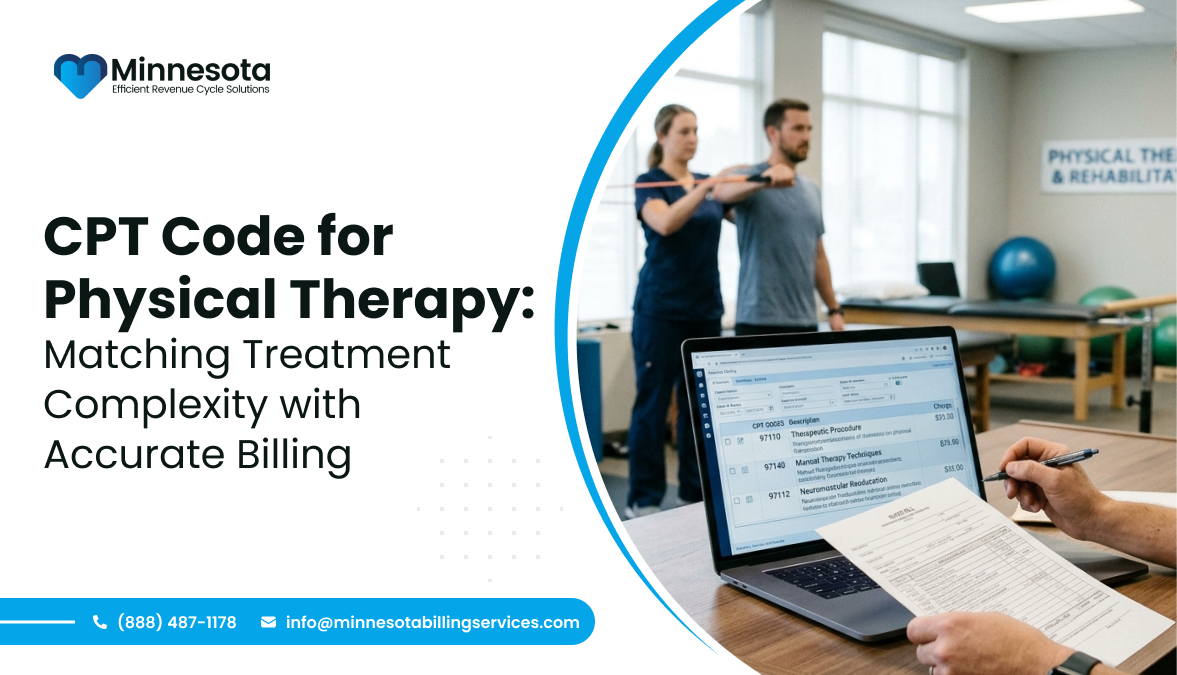
Physical therapy can have various codes depending on the service being provided. It is important to consider the patient’s impairments, purpose of the service and the therapist’s skilled intervention. If these factors do not match to the correct code there could be issues with the coding and you may experience delays or denied claims.
The CPT code will depend on the service being provided and what the requirements are for the relevant payers. There are many different methods of physical therapy including therapeutic exercises, neuromuscular re-education, gait training, manual therapy and therapeutic activities. Understanding the purpose of the code and accurately documenting your treatments will help with choosing the correct code.
When coding for physical therapy clinics across Minnesota it is important to understand the authorization requirements, units of time, medical necessity and the requirements from the payers. This guide will help you understand how to match the complexity of the treatment to the correct CPT code.
Why Physical Therapy CPT Coding Starts with the Treatment Goal
Patients may use similar exercises however the skilled intervention will differ based on their individual impairments. For example, one patient may require strengthening following surgery whilst another may require balance training to help improve coordination.
There are three main factors to consider when coding:
- Patient impairment: Why are you providing treatment? What are they struggling with?
- Skilled intervention: What specific service did the therapist perform?
- Treatment objective: Why are you providing the treatment? How is it helping them achieve their functional goals?
Build the CPT Code Around the Treatment
Connect the patient’s needs with the skilled service and its intended outcome.
01. Identify the impairment
Determine the functional limitation that requires skilled attention.
02. Define the intervention
Describe the therapist’s skilled technique, training, or activity.
03. Link the goal
Show how the intervention supports a measurable functional outcome.
Performing repetitive knee movements would be considered as therapeutic exercise, as it would be done to increase strength, stamina and joint range. Activities which support the patient in improving their functional ability could also be considered as therapeutic activities.
A code indicating the actual intervention and reason should be selected.
Common CPT Codes Used in Physical Therapy
The following codes are commonly found on outpatients claims. You will need to ensure you are using the correct code for the service provided, documented and requirements for the payer.
| CPT code | Service | Typical purpose |
| 97110 | Therapeutic exercise | Improve strength, endurance, flexibility, and range of motion |
| 97112 | Neuromuscular reeducation | Improve balance, coordination, posture, and movement control |
| 97113 | Aquatic therapy | Provide therapeutic exercise in an aquatic environment |
| 97116 | Gait training | Improve walking ability, mobility, and stair negotiation |
| 97124 | Massage therapy | Provide qualifying massage techniques |
| 97140 | Manual therapy | Apply qualifying hands-on treatment techniques |
| 97530 | Therapeutic activities | Improve functional performance through dynamic activities |
| 97533 | Sensory integrative techniques | Address qualifying sensory integration needs |
| 97535 | Self-care/home management training | Improve daily living and home-management skills |
| 97542 | Wheelchair management | Train patients in wheelchair use and management |
| 97150 | Group therapeutic procedures | Provide qualifying therapeutic procedures to multiple patients |
These are just examples and should not be used instead of the CPT descriptors. Please make sure you are on the latest CPT codes and are aware of any requirements from your payers.
Physical Therapy Evaluation and Re-Evaluation Codes
Evaluation codes reflect the complexity of the initial assessment.
| CPT code | Evaluation level |
| 97161 | Low-complexity evaluation |
| 97162 | Moderate-complexity evaluation |
| 97163 | High-complexity evaluation |
| 97164 | Physical therapy re-evaluation |
You do not automatically get a higher-level code if there are multiple diagnoses or longer appointments. Make sure to document relevant findings.
If you have a standard progress note then this does not mean that you can bill 97164. You must give a reason as to why the patient is requiring a formal re-evaluation. This must be due to a significant change in their condition.
Matching Treatment Complexity with the Correct CPT Code
The purpose of the treatment will help you identify the correct code.
97110 vs. 97112: Strength and Movement Control
CPT Code 97110 is usually assigned to therapeutic activities for strengthening, endurance, range of motion and/or flexibility.
This could be a patient beginning resistant exercises gradually to strengthen his or her quadriceps following an injury to his or her knee. As they progress the therapist will alter the resistance, number of repetitions etc.
CPT Code 97112 can be used for Neuromuscular Re-education. If your treatment involves working on a patient’s balance, coordination, posture, proprioception and/or control then this could be the code to use.
Your patient may do weight shifting and/or postural control exercises to help their balance.
The purpose of the treatment determines which code to use. Do not code 97112 simply because the exercise requires concentration or coordination. Ensure you are documenting the purpose of the treatment.
Accurate CPT selection depends on the documented intervention and treatment goals, making professional medical coding services in Minnesota valuable for physical therapy practices that want to reduce coding errors and improve claim accuracy.
97140 vs. 97530: Manual Treatment and Functional Activity
CPT Code 97140 is used for qualifying manual therapy techniques. This could include joint mobilizations.
An example of this may be joint mobilizations to help improve limited movement due to an injury. Record what you are working on, how you are working on it, why and how they have reacted.
CPT Code: 97530 Therapeutic activity, dynamic, to improve functional performance. The patient may undertake transfer activities, reaching activities or functional movement patterns to help improve their independence following hip surgery.
Whilst both could include movement the purpose of the treatment will vary. Manual therapy will focus on qualifying hands-on techniques.
97116 vs. 97530: Gait Training and Functional Mobility
CPT Code 97116 is used for qualifying gait training. This could be appropriate if the therapist is training the patient to improve their gait, ambulation or use of an aid.
CPT Code 97530 may be used if the treatment includes dynamic activities to improve performance in daily activities.
Walking with a cane to help improve gait may be coded as 97116. Functional transfer activities can be billed with code 97530.
Be sure to indicate what type of functional transfer activity you did and what impairment it was related to.
SERVICE REFERENCE
Which Therapy Service Are You Reporting?
Compare the primary focus of common physical therapy interventions.
🏋️
Therapeutic Exercise
Strength, endurance, flexibility, and range of motion.
⚖️
Neuromuscular Re-education
Balance, posture, coordination, and movement control.
🚶
Gait Training
Walking mechanics, ambulation, and assistive-device use.
🤲
Manual Therapy
Qualifying hands-on techniques, including joint mobilization.
🪜
Therapeutic Activities
Dynamic activities that support functional performance.
Timed CPT Codes: Converting Treatment Minutes Into Units
Many of the CPT codes for physical therapy will be time based. They will be charged in 15-minute units. For Medicare they use the 8-minute rule to determine how many units you can charge for qualifying time-based treatments.
For additional guidance on Medicare therapy billing, review the CMS resource on outpatient rehabilitation therapy documentation requirements, including timed and untimed codes and the 8-minute rule.
The image below shows the basics of how many units you can charge for.
Turn Treatment Time Into Billable Units
A quick reference for qualifying timed therapy services.
23 min
10 min
8 min
41 min = 3 units
Illustrative reference based on the article’s example. Apply the applicable payer rules and document the actual time for each service.
If you are completing multiple time-based treatments you will need to calculate the total amount of qualifying time-based treatment. Once you have this you can split the units into the treatments you have completed.
Example of Calculating Multiple Treatment Units
Consider a physical therapy session involving:
- 23 minutes of therapeutic exercise (97110)
- 10 minutes of manual therapy (97140)
- 8 minutes of neuromuscular reeducation (97112)
The total time-based treatment is 41 mins meaning you can charge 3 units of time-based treatment.
As all treatments were completed for 8 mins or above you would charge 1 unit for each code.
Ensure you are noting how long you spend on each intervention. You should also be noting how much time-based treatment you have completed.
You should not be converting units by looking at the appointment length. Do not include the wait time for the patient or any time that the patient is at rest, or doing any activities that they can carry out themselves.
There may be other requirements when it comes to commercial insurance providers. Always review the guidelines for physical therapy coding.
Untimed Services and Modality Coding
Evaluation codes (97161-97163) and re-evaluation (97164) are generally non-time based. The units will not be calculated by adding the time spent on the evaluation.
Modalities in physical therapy need to be carefully considered. Some common ones include:
- 97010 Heat/Cold Packs
- 97032 Attended Electrical Stimulation
- 97035 Ultrasound
- G0283 Unattended Electrical Stimulation (if qualifying for Medicare).
Coverage and requirements will vary for each payer. You cannot expect that every modality will be billed separately. Be sure to check coverage, medical necessity and definitions of the codes. Please consider any applicable bundling adjustments.
Documentation That Supports Skilled Physical Therapy
A simple entry such as ‘Therapeutic exercise provided’ would offer little evidence to back up your claim.
A good documentation should include:
- Patient-specific disability: Identify the impairment that is being addressed such as decreased joint ROM, muscle strength, balance, or ambulation.
- Measurable findings: Document any pertinent measurements such as strength, range of motion, balance performance, and functional limits.
- Skilled intervention: Describe exercises, manual techniques, or training activities provided. Explain how the therapist tailored treatment to the patient’s needs.
- Duration of treatment: Record actual time spent in performing each timed service. Time the treatment minutes separately from overall appointment time.
- Patient response: Describe patient tolerance, progress, limitations and responsiveness to intervention.
- Functional goals: Relate treatment to the plan of care. For instance, strengthening may assist in safer stair climbing, and balance training may enhance independent mobility.
- Need for continued expert care: Explain why the patient needs continued skilled care and how the treatment plan changes as their condition improves.
This can help to show that the CPT code you are claiming for reflects what you have provided.
Modifiers and Payer Edits That Affect Physical Therapy Claims
Within physical therapy you may provide multiple procedures within one visit. This doesn’t necessarily mean you will be able to claim for all of them.
National Correct Coding Initiative (NCCI) – There are some procedure-to-procedure edits within this. Physical therapy providers should review the CMS National Correct Coding Initiative (NCCI) edits to identify code combinations that may trigger payment edits and understand when an appropriate modifier may apply.
Common modifiers:
- GP – Indicates services provided as part of an outpatient physical therapy plan of care.
- CQ – Indicates a qualifying service provided in whole or in part by a physical therapist assistant, in accordance with Medicare rules.
- 59 – Indicates a distinct procedural service.
- XU – Indicates an unusual non-overlapping service where applicable.
You may come across an NCCI edit between codes 97140 and 97530. You shouldn’t automatically apply modifier 59 or XU. The documentation should show that they were separate services and were provided in separate times if needed. The appropriate edit should also allow for this modifier.
Always consider what the current rules are for the payer and what has happened in practice.
Common Physical Therapy Coding Mistakes
Even experienced clinics can get into trouble with incorrect coding.
| Common error | Potential consequence | Better approach |
| Selecting codes based on exercise appearance | Incorrect code selection | Match the code to the clinical purpose |
| Reporting unsupported timed units | Unit-related denials | Compare treatment minutes with reported units |
| Using 97164 for routine progress notes | Re-evaluation denial | Document a clinically justified change |
| Reporting overlapping services | NCCI or bundling issues | Review service timing and applicable edits |
| Reusing identical treatment notes | Weak support for skilled care | Document patient-specific interventions |
| Ignoring authorization requirements | Authorization-related denials | Verify benefits and obtain required approval |
| Using unsupported modifiers | Compliance and reimbursement risks | Confirm modifier requirements before submission |
Having a standardized review process will help identify these issues prior to claim submission.
When physical therapy claims continue to face coding, authorization, or medical necessity denials, professional denial management services in Minnesota can help identify recurring problems, review supporting documentation, and manage appropriate appeals.
A Pre-Submission Checklist for Physical Therapy Claims
Before making your claim, you should ensure:
- Patient details and insurance details are correct.
- Coverage and authorization requirements.
- Diagnosis matches plan of care.
- Correct CPT code used.
- Complexity of evaluation.
- Correct time spent on treatment.
- Correct units for each timed service.
- Untimed services have been reported separately.
- Appropriate modifiers and NCCI edits.
- Medical necessity justification.
- Specific rules for the payer.
Is This Physical Therapy Claim Ready?
Patient & Coverage
- Confirm patient information
- Check active insurance
- Review therapy benefits
Clinical Documentation
- Match diagnosis to treatment
- Record skilled interventions
- Support medical necessity
Coding & Units
- Validate the CPT selection
- Check timed-service minutes
- Confirm reported units
Payer Requirements
- Verify authorization
- Review applicable modifiers
- Check payer edits and policies
A consistent pre-billing check can help catch missing information and prevent avoidable claim issues.
Physical therapy clinics can use insurance eligibility verification services to confirm patient coverage, review therapy benefits, and identify prior authorization requirements before treatment begins.
This is especially important if you are providing multiple treatments.
How Billing Support Can Improve Physical Therapy Revenue
Selecting the correct CPT code is just one aspect of ensuring you receive payment for your physical therapy. You also need to make sure you’ve got systems in place to determine if the patient is eligible, get authorization, submit claims, post payments, follow up on any denials and manage your accounts receivable.
Understanding each stage of the medical billing revenue cycle management process can help physical therapy practices identify workflow gaps and improve reimbursement follow-up.
If you are struggling to keep your finances in order, then physical therapy medical billing services can assist you out.
Professional billing support may include:
- Checking CPT and ICD-10 coding.
- Checking claims.
- Identifying missing documentation.
- Monitoring rejections and denials.
- Managing amended claims and appeals.
- Following up on outstanding accounts.
- Monitoring trends in payment and common issues.
Accurate payment posting also helps clinics identify underpayments, contractual adjustments, and outstanding balances; learn more in our guide to payment posting in medical billing.
Minnesota practices can use broader medical billing in Minnesota to aid you with coding, insurance checks, claims, and your revenue cycle.
Specialized medical coding can help verify the therapies provided and the codes used. Good denial management can help identify common issues with claims.
If you are searching for a medical billing company that specializes in physical therapy, you will discover that a streamlined process may take the stress of administration off your back and allow you to focus on providing the best care for your patients.
Conclusion
You want to ensure that there is a connection between the patients’ functional limits, skilled intervention, treatment goals, time spent and coding rules to decide on the appropriate CPT code for your physical therapy.
Codes 97110, 97112, 97116, 97140 and 97530 are different methods. The codes you choose will depend on the therapy you provide and what documentation you have to explain this. Modifiers and payer regulations, as well as time-based units also affect your claim.
A uniform coding and billing system in your Minnesota physical therapy business can assist reduce avoidable errors, improve your paperwork and make your payments more predictable.
Physical therapy practices searching for the best medical billing company in Minnesota can partner with Minnesota Billing Services for coding support, insurance verification, claims management, denial follow-up, and revenue cycle assistance.
Frequently Asked Questions
What is the most common CPT code for physical therapy?
There isn’t one single code for every physical therapy visit. Common codes include 97110 (therapeutic exercise), 97112 (neuromuscular re-education), 97116 (gait training), 97140 (manual therapy) and 97530 (therapeutic activities).
Is 97110 a timed code?
Yes, CPT code 97110 represents a 15-minute timed service. Ensure you have documentation to justify the time provided and calculate your units based on your payers’ rules.
What is the difference between 97110 and 97530?
97110 refers to therapeutic exercises to improve strength, endurance, range of motion or flexibility. 97530 refers to dynamic therapeutic activities to improve function.
How does Medicare calculate physical therapy units?
Medicare generally use the 8-minute rule for timed therapies. Calculate your total time spent on timed treatments and allocate justified units.
Can a Physical Therapist claim for both 97140 and 97530 on the same date?
It is potentially possible. Ensure you check what NCCI edits apply and what the payer rules are. The services need to be separate, justified by documentation and provided in separate times if needed.
Do I need to complete a re-evaluation for every physical therapy session?
No, you shouldn’t automatically claim for 97164 during a planned course of treatment. There needs to be a clinical reason for doing so and documentation to justify it.
Why are my physical therapy claims being denied?
Common reasons include incorrect coding, unjustifiable units, incomplete treatment notes, no authorization, concerns around medical necessity, incorrect modifiers and breach of payer rules.