
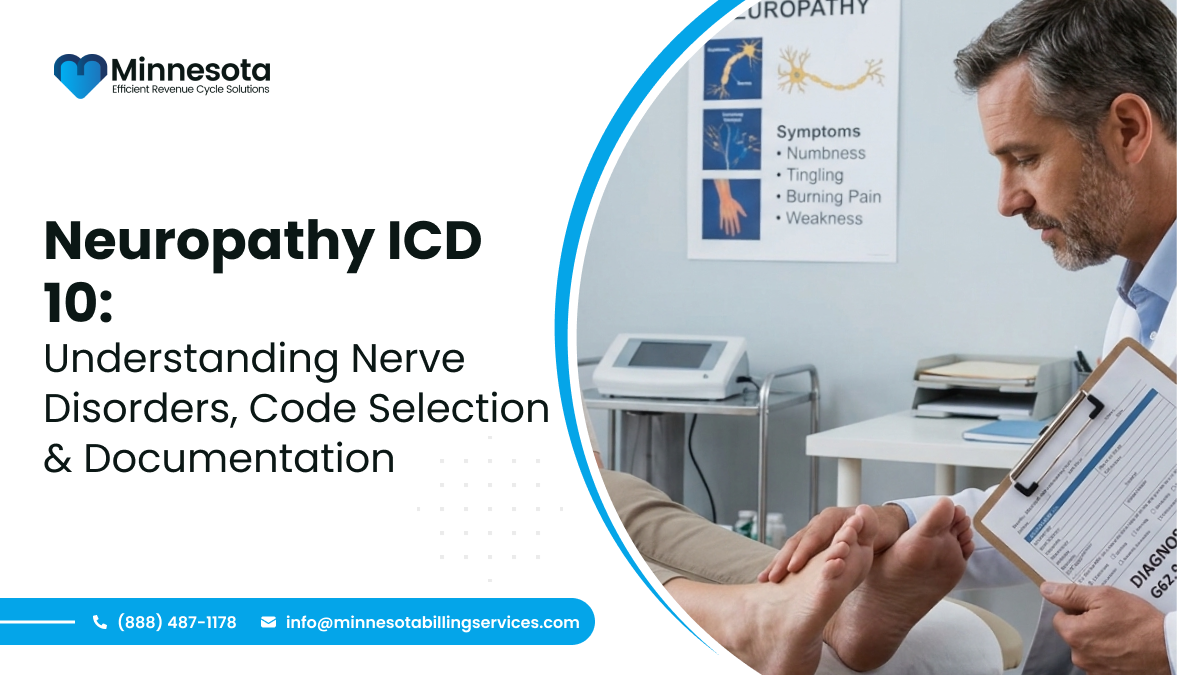
Neuropathy can describe a wide range of conditions affecting the peripheral nerves. Patients may experience numbness, tingling, burning pain, weakness, sensitivity to touch, or changes in sensation. For healthcare providers and medical coders, however, identifying the correct neuropathy ICD 10 code requires more than matching the word “neuropathy” to a code.
Factors which can lead to code selections are the provider’s notes, the Etiology, Nerve Involved and other Excludes 1 conditions or whether the condition is related to another specified disease. Look at G62.9, polyneuropathy, unspecified. The provider notes would need to indicate polyneuropathy and the Nerve Involved to report polyneuropathy, Mononeuropathy. Several synonyms of polyneuropathy are in the ICD-10-CM as well as, hereditary neuropathy, inflammatory polyneuropathy, toxic neuropathy, etc.
More accurate diagnosis coding in medical offices from neuropathy ICD 10 codes means cleaner claims, fairer reimbursement, and more standardized documentation. This is a guide on Neuropathy ICD 10 including the most relevant ICD 10 for Neuropathy codes, how to find your code(s), documentation challenges and Neuropathy billing.
What Is Neuropathy?
Neuropathy: Start With the Clinical Picture
The nerve involved, cause, distribution, and provider’s diagnosis can all influence the final ICD-10-CM code.
Nerve Type
Determine whether the record supports a localized or broader nerve disorder.
Etiology
Look for a documented diabetic, toxic, drug-related, hereditary, or inflammatory cause.
Distribution
Review the documented nerve, limb, location, and laterality where applicable.
Provider Diagnosis
Let the assessment and established diagnosis guide code selection.
Neuropathy is damage to and disease of a nerve. What is Peripheral Neuropathy? Peripheral neuropathy refers to a disease of the nerves that are outside of the brain and spinal cord. These can involve the hands, feet, arms or legs.
Symptoms can vary depending on the nerves involved. A patient may report:
- Tingling or “pins and needles”
- Burning or shooting pain
- Numbness
- Muscle weakness
- Loss of sensation
- Increased sensitivity
- Problems with balance or coordination
- Changes in reflexes
Neuropathy can result from, but isn’t limited to: Diabetes, Chemicals, Toxins, Alcohol use or abuse, Hereditary, Autoimmune or inflammatory disorders, Nutritional deficiencies or nutritional imbalances, infections, trauma, or an unknown.
This confuses the coding aspect of this variety. Neuropathy is not a diagnosis code, per se, it can, however, be an ICD-10-CM code or a collection of codes. The code varies depending upon what the provider sets up.
Neuropathy ICD 10: Which Codes Are Commonly Used?
The list of effective G codes from the neuropathy range depends on the type and because that has been captured. Some common classifications we see are G60, G61, G62, G63, along with other nerve conditions outside of the neural system chapter.
| ICD-10-CM Code | Description | Coding Consideration |
| G60.3 | Idiopathic progressive neuropathy | Used when the documented neuropathy is idiopathic and progressive |
| G60.9 | Hereditary and idiopathic neuropathy, unspecified | Appropriate only when documentation supports this category |
| G61.0 | Guillain-Barré syndrome | Specific inflammatory neuropathy requiring appropriate clinical documentation |
| G61.81 | Chronic inflammatory demyelinating polyneuritis | Used for documented CIDP |
| G62.0 | Drug-induced polyneuropathy | Indicates polyneuropathy attributed to a drug |
| G62.1 | Alcoholic polyneuropathy | Used when alcoholic polyneuropathy is documented |
| G62.2 | Polyneuropathy due to other toxic agents | Used when documentation establishes a toxic cause |
| G62.8 | Other specified polyneuropathies | Used for specified conditions that do not fall into another applicable category |
| G62.9 | Polyneuropathy, unspecified | Commonly considered when documentation establishes polyneuropathy but does not specify the type |
| G63 | Polyneuropathy in diseases classified elsewhere | Used when neuropathy is associated with an underlying disease and coding instructions apply |
Neuropathy Coding: Follow the Documented Cause
Several code families may apply depending on the type and etiology recorded by the provider.
G60
Hereditary and idiopathic neuropathy categories
G61
Inflammatory neuropathy and related disorders
G62
Various polyneuropathy categories and unspecified cases
G63
Polyneuropathy associated with diseases classified elsewhere
These categories are not interchangeable. Review the provider’s diagnosis and applicable coding instructions before choosing the final code.
CMS’s current FY 2027 code listings include these neuropathy and polyneuropathy categories, including G62.0, G62.1, G62.2, G62.8, G62.9, G63, and several inflammatory and hereditary neuropathy codes.
Is G62.9 the ICD 10 Code for Neuropathy?
G62.9 — Polyneuropathy, unspecified is often encountered when a provider documents polyneuropathy without further specification. The code description also includes “neuropathy NOS.”
But don’t just order it for every “neuropathy” in the chart. A coder should challenge the record to decide if it is appropriate to be more precise.
Additionally, in case the diabetic polyneuropathy has been reported by the doctor than the diabetes-with-neuropathy code of diagnosis can pop out rather than G62.9.
That slight margin may be the one that sets your medical billing apart.
Peripheral Neuropathy ICD 10 Coding
One can sometimes be reluctant to use the phrase peripheral neuropathy ICD 10 as “peripheral neuropathy” may not always refer to a certain number.
The coder should review the provider’s complete diagnosis and determine whether the condition is:
- Unspecified
- Diabetic
- Drug-induced
- Alcohol-related
- Toxic
- Hereditary
- Inflammatory
- Idiopathic
- Associated with another disease
- A specific mononeuropathy
If the documentation provides a specific etiology or neurological condition, it should be used to select a specific code instead of selecting an unspecified code.
Especially when doing research on records from other fields like neurology, primary care, endocrinology, pain management and so on, and other sub-specialties with preponderance of nerve pathology.
Diabetic Neuropathy ICD 10: Don’t Default to G62.9
Diabetes is one of the main circumstances in which coders require to differentiate between an underlying diagnosis and an unspecific neuropathy diagnosis.
For example, current ICD-10-CM coding includes:
- E10.40 — Type 1 diabetes mellitus with diabetic neuropathy, unspecified
- E10.41 — Type 1 diabetes mellitus with diabetic mononeuropathy
- E10.42 — Type 1 diabetes mellitus with diabetic polyneuropathy
- E10.43 — Type 1 diabetes mellitus with diabetic autonomic (poly)neuropathy
- E11.40 — Type 2 diabetes mellitus with diabetic neuropathy, unspecified
- E11.41 — Type 2 diabetes mellitus with diabetic mononeuropathy
- E11.42 — Type 2 diabetes mellitus with diabetic polyneuropathy
- E11.43 — Type 2 diabetes mellitus with diabetic autonomic (poly)neuropathy
CMS’s FY 2027 code listings confirm these diabetes-with-neurological-complication categories.
Therefore, if the provider submits CPT codes for type 2 DM with diabetic polyneuropathy (both in the same visit) and the visit is coded only as G62.9 the diabetic relationship is not there.
Same applies to other known and other identified types of diabetes, such as: type 1 diabetes, drug or chemical induced diabetes, etc.
G62.9 or Diabetes-Related Coding?
The documented relationship between diabetes and neuropathy can change the coding approach.
G62.9
Polyneuropathy, unspecified
May be considered when the provider establishes polyneuropathy but does not document a more specific type or cause.
E11.4x
Type 2 diabetes with neuropathy
When the provider establishes a diabetes-neuropathy relationship, review the appropriate diabetes complication category.
Mononeuropathy vs. Polyneuropathy
A helpful aspect of neuropathy coding is telling the difference between mononeuropathy and polyneuropathy.
Mononeuropathy of one nerve or a localized nerve territory, and to a single cranial or spinal nerve depending on the nerve and location: there may be more specific codes in G56 and G57.
Peripheral Neuropathy-Involves only one peripheral nerve. G62.9-Polyneuropathy, Unspecified The provider is aware the patient has polyneuropathy, but is unsure of the specific variety.
For example, current ICD-10-CM listings include:
- G56.90 — Unspecified mononeuropathy of unspecified upper limb
- G56.91 — Unspecified mononeuropathy of right upper limb
- G56.92 — Unspecified mononeuropathy of left upper limb
- G57.90 — Unspecified mononeuropathy of unspecified lower limb
- G57.91 — Unspecified mononeuropathy of right lower limb
- G57.92 — Unspecified mononeuropathy of left lower limb
- G58.9 — Mononeuropathy, unspecified
- G62.9 — Polyneuropathy, unspecified
The issue should be identified according to the provider’s diagnosis, and the anatomical and clinical description in the record.
When Should a More Specific Neuropathy Code Be Used?
Specificity should come from documentation—not assumptions made by the coder.
For example, the record may identify:
- The underlying cause
- The type of neuropathy
- The affected nerve
- The anatomical location
- Laterality
- Whether diabetes is related to the neuropathy
- Whether the condition is hereditary or idiopathic
- Whether medication or toxin exposure caused the neuropathy
- Whether an inflammatory disorder is responsible
Include some specific examples such as G62.0 Polyneuropathy due to drug or toxic agents, G62.1 Alcoholic Polyneuropathy, G62.2 Polyneuropathy in other toxic agents, etc.
A cause should not be assumed by the coder without the provider establishing the connection. Resolution may be necessary through coding and documentation policy if the provider has not made the connection.
Neuropathy Documentation Requirements
This process is made much easier with good documentation when coding for neuropathy diagnosis.
The reason for the illness must be supported by the writing of the carrier and also, when appropriate, the beginning or name of the disease.
Useful documentation may include:
Specific Diagnosis
“Neuropathy” alone may provide less information than a more specific diagnosis such as diabetic polyneuropathy, drug-induced polyneuropathy, or a documented mononeuropathy.
Underlying Cause
If the neuropathy is related to diabetes, medication, alcohol, toxins, hereditary disease, or another condition, the relationship should be documented when clinically established.
Location and Nerve Involvement
Any documentation that suggests the nerve, limb or distribution involved can sometimes help confirm that a more specific neurologic code is right.
Clinical Findings
Signs, symptoms and examination findings may help to support the diagnosis, but the coder needs to make a separation between the ‘noted’ examination findings and the diagnosis statement by the providers.
Diagnostic Testing
Additional relevant testing might be done such as nerve conduction studies, electromyography, lab testing, imaging and the list goes on based on individual circumstances. Testing does not generate a diagnosis code, testing requires the provider to document the diagnosis.
Common Neuropathy Coding Errors
Coding and documentation may not match even when the clinical diagnosis is obvious.
Using G62.9 for Every Neuropathy Diagnosis
G62.9 is not a substitute diagnosis for these situations. When the record describes a specific condition, the more specific diagnosis should be assigned.
Missing the Diabetes Relationship
If diabetic neuropathy is present the provider’s diabetes category should be used rather than an unspecified neuropathy code.
Coding a Suspected Cause as Confirmed
The medication or illness of the patient may suggest a possible etiology but coding guidelines should be used based on the documentation of the problem.
Choosing a Symptom Instead of an Established Diagnosis
Symptoms like numbness and tingling or pain may also be recorded on neurologic exam. When provider does have the diagnosis of neuropathy documented, the assessment should be reviewed for correct coding as opposed to substitution with symptom code.
Ignoring Laterality or Anatomical Detail
Some nerve conditions may be coded as right, left, bilateral or unspecified. If this level of detail is recorded in the documentation, coders are required to always code the specified detail.
How Accurate Neuropathy Coding Supports Medical Billing
Documentation and especially coding may impact compliance not only but have been linked with better claim transparency, medical-necessity review, payer processing, and revenue cycle management process.
Neurological and other specialists handling the nerve could have specific kinds of has, complex diagnosis codes, procedures, testing, consults, and services. Some of these claims may require additional review or corrections if diagnosis codes not representative of the medical record.
This is where our neurology medical billing services and professional coding solutions can assist your practice with revenue cycle management.
A structured billing process may include:
- Insurance eligibility verification
- Accurate diagnosis and procedure coding
- Claim submission
- Claim-status follow-up
- Denial management
- Payment posting
- Accounts receivable follow-up
- Patient balance management
- Documentation and coding review
Neurology Billing Considerations for Minnesota Practices
Neurosciences clinics in Minnesota have the option to work with payers like Medicare, Medicaid, Commercial Payers and Other Payers. Payer specific coverage, documentation, prior authorizations, coding and billing procedures are different for each payer.
The practice may wish to consider using a standard process for linking the documentation to the coding and billing process.
Don’t prioritize claim submission when seeking medical billing services for neurology The scope of a solid revenue-cycle process extends beyond claim filing when it comes to providing medical billing services for neurology.
How Medical Billing and Coding Services Can Help
Here is where the claims for this type of neuropathy usually start to differ with many claims, preexisting conditions or a neurologist.
Providing the right billing services will make your practice to be able organized that you will not be lost through verifying the documents, from choosing the diagnosis codes, to providing the bill and ensuring that you track the outstanding balances.
This can be helpful to a neurology practice that handles many different kinds of neuropathy, diabetic nerve diseases, nerve disorders or other chronic conditions.
“It also enables clinical teams to focus more on the delivery of care, freeing up revenue cycle processes to be managed by billing specialists.
A Practical Neuropathy ICD 10 Coding Checklist
Before submitting a claim involving neuropathy, consider the following:
- What diagnosis did the provider establish?
- Is the condition neuropathy, mononeuropathy, or polyneuropathy?
- Is an underlying cause documented?
- Is diabetes associated with the neuropathy?
- Does the diagnosis require a more specific code?
- Is laterality documented where applicable?
- Does the selected code accurately match the provider’s documentation?
- Are any required sequencing or “code first” instructions applicable?
- Does the claim contain supporting documentation when required?
- Has the current ICD-10-CM code set been checked?
Continue to use the current code set we talked about the annual update of ICD-10-CM. CMS states that the FY 2027 ICD-10-CM files are for encounters with dates of service from October 1, 2026 through September 30, 2027.
Neuropathy Coding Review Checklist
Before the claim moves forward, confirm that the diagnosis and supporting documentation tell the same story.
Provider Diagnosis
Is the actual neurological diagnosis clearly documented?
Type of Neuropathy
Is it polyneuropathy, mononeuropathy, or another documented condition?
Underlying Cause
Is diabetes, medication, alcohol, toxins, or another cause explicitly established?
Anatomical Detail
Check the affected nerve, limb, location, and laterality when applicable.
Coding Instructions
Review sequencing, Excludes notes, and other applicable ICD-10-CM instructions.
Final Claim Check
Confirm that the diagnosis reported on the claim is supported by the record.
Accurate coding starts with accurate provider documentation.
Final Thoughts
In choosing the best ICD 10 code for a neuropathy diagnosis, it really will depend on the diagnosis, the etiology, the type of nerve, as well as documentation. Unspecified polyneuropathy can also be coded with G62.9 but it isn’t an automatic neuropathy code.
The coding system has six options with which to code diabetic neuropathy, drug-induced neuropathy, alcoholic polyneuropathy, inflammatory neuropathy, hereditary issues and mononeuropathies. The key is to code that which the provider has recorded and identify the proper ICD-10-CM instruction to apply.
For practices that need support beyond diagnosis coding, working with the best medical billing services in Minnesota can help coordinate coding, claims, denial follow-up, and other revenue-cycle activities
Coding doesn’t only equal coding for practices who see complex neurological patients–that’s just part of a healthy revenue cycle. Claims management, denial follow-up, billings, eligibility checks, and medical coding services can streamline your billing system.
Frequently Asked Questions About Neuropathy ICD 10
What is the ICD 10 code for neuropathy?
There is no single code for every neuropathy diagnosis. G62.9 represents polyneuropathy, unspecified, while other codes apply to specific types and causes. The correct code should be based on the provider’s documented diagnosis.
What is the ICD 10 code for peripheral neuropathy?
The appropriate peripheral neuropathy ICD 10 code depends on the type and cause documented by the provider. G62.9 may apply when polyneuropathy is documented without further specification, but specific hereditary, toxic, drug-induced, inflammatory, diabetic, or nonneuropathic conditions may require different codes.
What is the ICD 10 code for diabetic neuropathy?
Typically, diabetic neuropathy is reported using the assigned diabetes code as: The example, E11.40, which depicts type 2 diabetes with diabetic neuropathy, unspecified. E11.42, which depicts type 2 diabetes with diabetic polyneuropathy.
Can G62.9 be used for diabetic neuropathy?
Not automatically. When the provider documents a causal relationship between diabetes and neuropathy, the appropriate diabetes-with-neurological-complication code should be considered. G62.9 should not simply replace a more specific documented diabetic neuropathy diagnosis.
Why is accurate neuropathy coding important for billing?
Correct coding assists to keep the patient’s claim accurate to the condition documented in their chart. Improved correlation of documentation, diagnosis codes, procedures, and requirements can minimize unnecessary claim issues and improve a more structured revenue cycle.