
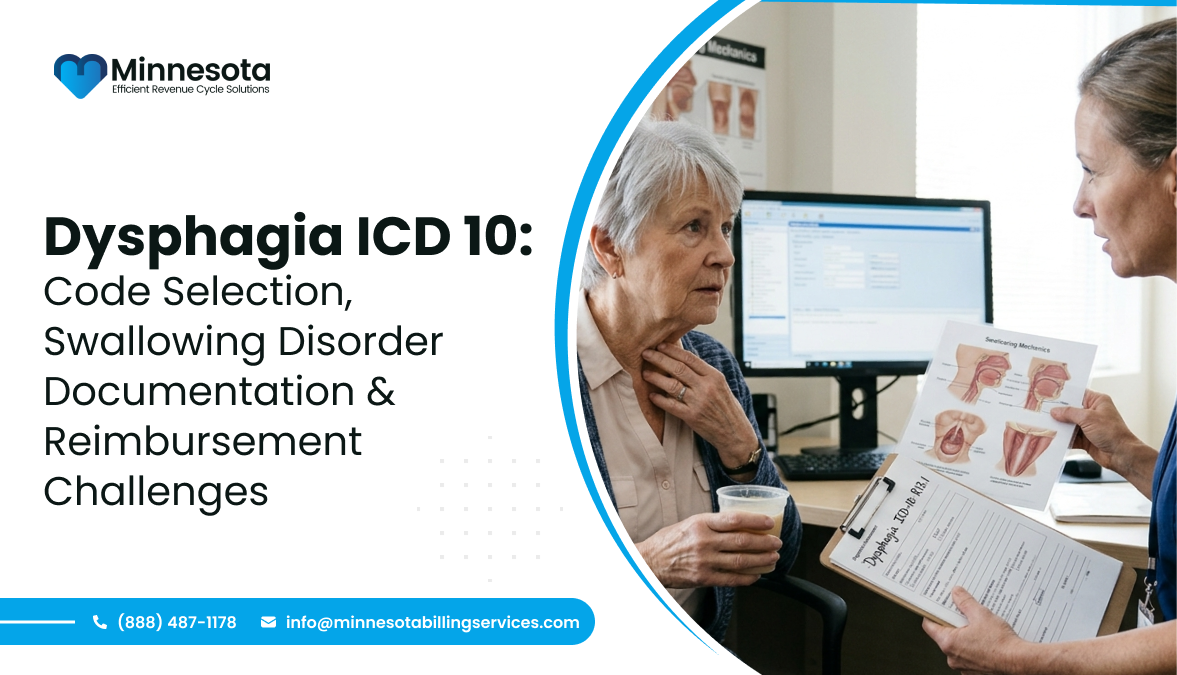
Dysphagia is a swallowing problem which can cause issues for patients when trying to pass food, liquid and saliva through their mouths and into their stomachs. Healthcare professionals will often encounter dysphagia as part of neurological diseases, anatomical issues, esophageal disorders or other medical issues. Correctly coding your patient’s diagnosis can help you to correctly document their diagnosis and make accurate claims.
The patient’s stage of dysphagia will need to be identified. The ICD-10-CM guidelines should then be followed to ensure that you assign the correct ICD 10 code. If there is a lack of information within the patient’s medical records or the billing team use an incorrect code, then claim rejections, delayed payment and further verification from the payers may occur.
Knowledge of the dysphagia diagnosis codes and common billing problems will help to allow you to correctly code your patients.
In this tutorial we will go over common dysphagia codes, what to document, common mistakes to avoid, payment considerations and ideas to optimize your billing process.
What is dysphagia?
Dysphagia refers to difficulty in swallowing. Patients may report difficulty in swallowing, sometimes feeling that food is sticking, or that they have to work harder to swallow. This can occur at any point along the esophagus, mouth or throat.
For more information about swallowing difficulties and their causes, read the MedlinePlus guide to swallowing disorders.
Common causes/related conditions include:
- Stroke and other neurological issues
- Parkinson’s disease and other movement disorders
- Narrowing or anatomical issues in the esophagus
- Gastro esophageal reflux disease (GERD)
- Head and neck issues
- Muscle weakness affecting swallowing
- Complications from certain surgery/medical treatment
Healthcare professionals typically evaluate swallowing disorders through clinical assessments, instrumental tests, imaging, endoscopy, or other appropriate methods.
For accurate medical coding, the provider must document either a general swallowing problem or a specific swallowing disorder.
Dysphagia ICD 10 Codes – Common Diagnosis Codes
Dysphagia comes under the R13 category in ICD-10-CM. The correct code will depend on what type or phase of dysphagia has been documented.
| ICD-10-CM code | Description |
| R13.10 | Dysphagia, unspecified |
| R13.11 | Dysphagia, oral phase |
| R13.12 | Dysphagia, oropharyngeal phase |
| R13.13 | Dysphagia, pharyngeal phase |
| R13.14 | Dysphagia, pharyngoesophageal phase |
| R13.19 | Other dysphagia |
You should always check the latest ICD 10-CM codes to ensure you are using the correct codes, with correct descriptions and guidance.
R13.10 – Dysphagia, unspecified
R13.10 is used when the provider has documented dysphagia but no specific phase or type.
For example, if the clinician has documented ‘swallowing difficulties’ but doesn’t state what phase of swallowing is causing the issue. If there isn’t enough information to determine a more specific code then you could use unspecified.
However, coders should always review all the documentation to see if there is a more specific phase of dysphagia documented. If the provider has documented a more specific phase, then you should use that code.
If there isn’t enough information, you should ask the provider a compliant question to determine the diagnosis. You shouldn’t assume what phase of dysphagia the patient has based on symptoms or investigations.
R13.11 – Dysphagia, oral phase
R13.11 is used for dysphagia which occurs in the oral phase. The oral phase includes chewing and preparing the food for swallowing. Food is also moved to the back of the mouth.
Notes may refer to oral dysphagia, such as poor oral control, difficulty chewing or difficulty moving food to the throat. The provider will need to have made an assessment to support this code.
R13.12 – Dysphagia, oropharyngeal phase
R13.12 is used for dysphagia which occurs in the oropharyngeal phase. The oropharyngeal phase is a coordinated passage of food through the throat.
Patients may have difficulties initiating the swallow or may cough on eating. This does not alone confirm oral pharyngeal dysphagia. The provider must have made an assessment to support this code.
R13.13 – Dysphagia, pharyngeal phase
R13.13 is used for dysphagia which occurs in the pharyngeal phase. The pharyngeal phase involves swallowed materials moving through the throat.
The medical records should document the diagnosed phase and relevant clinical findings. Providers should not assign this code solely because a patient reports choking or discomfort when swallowing.
R13.14 – Dysphagia, pharyngoesophageal phase
R13.14 is used when the provider has documented dysphagia which occurs in the pharyngoesophageal phase. The pharyngoesophageal phase is the movement of food down the throat.
Study the diagnosis and any findings carefully. If the provider has recorded a different phase of swallowing or anatomical condition, then you may need to use a new code or add on a code based on suggestions.
R13.19 – Other dysphagia
R13.19 may be used if the type of dysphagia documented falls under ‘other’.
This shouldn’t be used as a general code in place of R13.10 or the specific phase codes. The medical records should support this code and follow current guidance.
Dysphagia ICD 10 Coding Guidelines
Correct coding requires more than selecting a code the R13 category. Coding professionals need to verify that it was documented in the medical record and that it meets the appropriate ICD-10-CM coding criteria.
Select the Most Specific Supported Code
When the provider identifies a swallowing phase, choose the code that matches the documented diagnosis. Avoid using R13.10 automatically when the record supports greater specificity.
At the same time, do not assign a phase-specific code based on assumptions. The documentation must support the diagnosis.
Distinguish Dysphagia from Its Underlying Cause
Dysphagia can occur with stroke, Parkinson’s, GERD or other medical issues but this does not necessarily mean the patient has a certain type of dysphagia.
The root cause should be recorded and coded where applicable. For example, a patient with a history of stroke and dysphagia of the oropharynx, the coder will identify the correct codes to apply. The coding instructions will be used as required.
Follow Current Coding Instructions
The coding explanations and requirements may change. Don’t forget to use the up-to-date ICD 10-CM codes and payer rules applicable for this fiscal year.
Professional Medical Coding services in Minnesota can review your coding for suggestions and ensure you are coding correctly.
Clinical Documentation Requirements for Dysphagia
Having complete documentation can help you to support your diagnosis, show medical necessity and allow your coding team to create accurate claims.
Document Symptoms and Clinical Findings
Symptoms and associated findings should be included in the medical records. These may include trouble swallowing solids, coughing when eating, trouble commencing a swallow, or the feeling of food sticking in the throat.
This will provide clinical context, but will not automatically confirm certain diagnosis. The provider must have made an assessment to support the code.
Identify the Swallowing Phase When Established
If the phase of dysphagia has been clinically determined then you should document this. This can include oral, oropharyngeal, pharyngeal or pharyngoesophageal dysphagia.
If the note just says ‘swallowing difficulties’ then you may not be able to use the specific codes. Having clear diagnostic notes can also help coders to differentiate between R13.10 and the more specific codes.
Include Relevant Assessment Findings
If clinically indicated then the provider may have carried out assessments or instrumental tests. The records should include a summary of any relevant findings. This should explain how they have helped with the assessment and treatment plan.
Learn more about tests used to evaluate swallowing difficulties in the MedlinePlus guide to dysphagia tests.
If there isn’t enough information or conflicting information then the coding team should follow relevant guidelines and policies.
Support Medical Necessity
The documentation should explain why the patient requires this service and how it relates to their diagnosis. Document the presenting concerns, clinical assessment, treatment plan, recommendations, and required follow-up.
Having complete documentation can help answer any questions from payers but doesn’t guarantee payment.
Common Dysphagia Coding and Billing Errors
When correctly identified, there may still be issues with coding and claim creation that can lead to delays to repayment.
Using an Unspecified Code When Greater Specificity Is Available
This may happen if a coder has used R13.10 due to the note being vague and only referencing dysphagia. However, there may be more specific information elsewhere in the record.
Prevention: Review the complete medical documentation to select the most specific and appropriate diagnosis code.
Assigning a Specific Code Without Supporting Documentation
Coughing or choking on food doesn’t necessarily mean someone is suffering with oropharyngeal or pharyngeal dysphagia.
Prevention: Ensure the documented diagnosis supports the selected code and submit all provider queries through a compliant querying process.
Reporting an Unsupported Underlying Condition
Whilst dysphagia can be a symptom of many diseases, coders shouldn’t assume the underlying condition based on the symptoms of dysphagia.
Prevention: Ensure the medical records support every reported diagnosis and follow all applicable coding guidelines.
Incomplete or Inconsistent Clinical Notes
The assessment may have reference to only one stage of dysphagia, though other areas of the record may refer to a different stage. This can be confusing and raise questions.
Prevention: Encourage consistent use of the diagnosis. Where possible ensure any inconsistencies are resolved. Offer positive feedback to clinicians.
Reviewing common coding mistakes can help billing teams identify documentation gaps, improve claim accuracy, and strengthen their pre-submission review process.
Claim Submission and Follow-Up Problems
Even with good coding, the claim could have problems with demographics, eligibility, authorization, changes, filing dates.
Prevention: Include dysphagia claims in routine inspections. Professional medical billing can aid you in creating, submitting, tracking and following up on claims.
How to Reduce Dysphagia Claim Denials
Having a consistent claiming process will help practices to identify any avoidable errors. Whilst it won’t completely prevent any denials, using these methods can help to create high-quality claims.
- Ensure they are eligible and authorized: Before providing services, ensure they are eligible and authorized. Check what coverage they have, what benefits they have, if they need a referral and if they need prior authorization.
- Check Diagnosis & Procedure Information: Ensure the diagnosis and procedures are accurate and match the services provided. Ensure they meet any requirements from the payers.
- Track Rejections and Denials: Identify the reasons for claim rejections and denials, correct any errors, and submit appeals with supporting evidence within the required deadlines.
- Look for Trends: Look for any trends in the reasons for denial. This will help to identify if there are any documentation, coding or administration issues regularly affecting the claim.
Having a process in place to manage denials will help practices to identify why the issue has occurred. For further information see our resource on the Revenue Cycle Management Process.
Specialties That May Encounter Dysphagia Coding
Dysphagia can be seen in many specialties.
- Neurology: Neurologists may see patients with dysphagia due to stroke, Parkinson’s and other neurological conditions.
- Family Medicine: Primary care providers may assess patients with dysphagia issues and make initial notes. They may also refer to specialists.
- Internal Medicine: Internists may manage patients with complex medical conditions that are causing dysphagia.
Practices can look at specialty specific resources like Family Practice Billing Services and Mental Health Billing Services.
Best Practices for Accurate Dysphagia ICD 10 Coding
Healthcare organizations can implement the below to ensure coding is consistent.
- Use Current References: Ensure you know what ICD-10-CM code to use and what guidance is available. This should be done for each date of service.
- Check Full Medical Records: Ensure the diagnosis is accurate by checking what the provider has noted in their assessment, any relevant findings and treatment plan.
- Don’t Assume: Never assume which stage of dysphagia or underlying disease is present without enough documentation.
- Audit Coding: Check a sample of dysphagia claims to identify any common errors. This can help to identify training needs.
- Give Feedback on Documentation: Help clinicians improve their documentation by identifying any missing details in the diagnosis.
- Keep Track of Billing: Identify any issues with claims being denied, coding errors and unpaid balances.
This will help link the documentation to the correct diagnosis coding.
Conclusion
Correct coding of dysphagia using ICD 10 will involve using the right R13 code. If a diagnosis has been made for a specific phase of dysphagia, this should be documented. Ensure you’re following current ICD-10-CM guidelines.
Providers should select the appropriate code from R13.10, R13.11, R13.12, R13.13, R13.14, and R13.19 based on the documented type of dysphagia in the medical records.
To improve reimbursement, healthcare practices should maintain complete documentation, verify patient eligibility, submit accurate claims, and follow up promptly on denied claims. Having consistent coding audits and educating staff can help to reduce any avoidable errors.
If you’re experiencing pressure due to coding delays, incomplete claims or repeated denials, consider using a professional service. Minnesota Billing Services offer medical billing and coding solutions to help healthcare practices manage their admin.
Healthcare practices looking to improve coding accuracy, reduce avoidable claim errors, and strengthen reimbursement workflows can explore medical billing services in Minnesota from Minnesota Billing Services.
Frequently Asked Questions About Dysphagia ICD 10
What is the ICD 10 Code for Dysphagia?
Dysphagia is coded under R13 in the ICD-10-CM. Common codes include:
- 10 – Unspecified Dysphagia
- 11 – Oral Phase Dysphagia
- 12 – Oropharyngeal Phase Dysphagia
- 13 – Pharyngeal Phase Dysphagia
- 14 – Pharyngoesophageal Phase Dysphagia
- 19 – Other Dysphagia
When Should I Use R13.10?
R13.10 may be appropriate if the provider has made no mention of what type of dysphagia is present. However, if there is more specific information to back up a diagnosis, this should be considered.
What is the ICD 10 Code for Oropharyngeal Dysphagia?
Oropharyngeal Phase Dysphagia is coded R13.12. This should be backed up by the provider.
Can I Code an Underlying Condition?
Yes, if there is supporting evidence in the medical records and any relevant coding guidance. Rather than assuming all associated conditions need to be coded, check the relevant guidance.
Can Incorrect Coding Cause Claims to Be Denied?
Yes. If diagnosis codes lack supporting documentation or don’t match the services provided, billing teams may need to query the provider for clarification. Ensuring accurate coding and regular checks will help reduce any avoidable errors.
How Can Medical Billing Help with Dysphagia Claims?
Medical billing can help practices to check the information, submit claims, track responses from payers, track any outstanding balances and follow up on any denials. However, this can’t guarantee claims will be approved.