
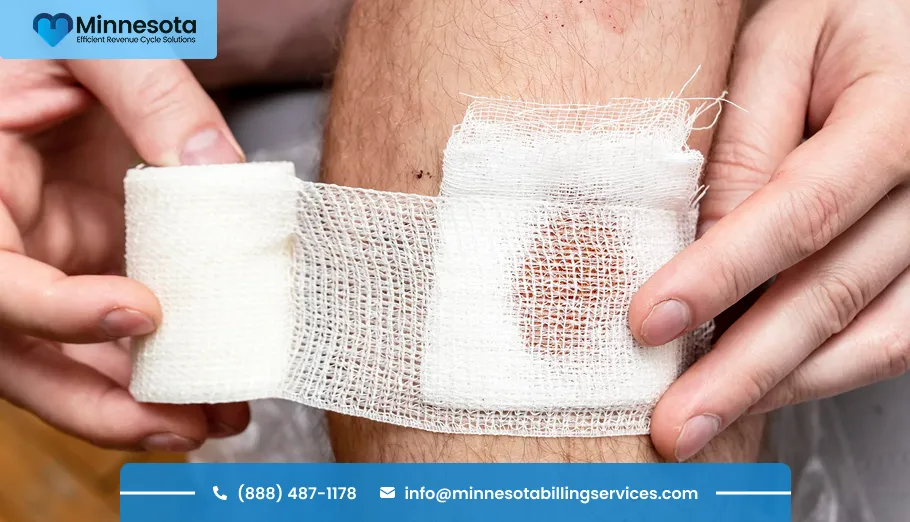
A physician spends 45 minutes debriding a diabetic foot ulcer. The tissue removed reaches the subcutaneous fat. The biller codes 97597. It’s paid, but only a small fraction of the cost. Nobody flags it. The clinic has lost hundreds of dollars on that one visit, and many dozens each month.
That is what miscoding wound debridement looks like in real life. It is not always a denial. Sometimes it is just a quiet underpayment.
Let’s discuss wound debridement CPT codes used in 2026, how each one works, when to use it, and what documentation makes or breaks the claim.
What Is Wound Debridement in Medical Billing?
Debridement is the cleaning of a wound to promote healing by removing dead, infected, or nonviable tissue. In terms of CPT coding, the debridement wound CPT code can be determined by three factors:
- The type of debridement performed
- The deepest tissue layer removed
- Total wound surface area measured in square centimeters.
Code selection is not based on wound depth. It is based on what tissue was actually taken out. That distinction is where most billing errors begin.
Most Common CPT Codes for Wound Care Debridement
There are 4 most common wound care CPT codes:
- Selective debridement
- Non-selective debridement
- Surgical debridement
- Callus or corn removal.
These are used for different types of treatment.
| CPT Code | Description | Tissue Level | Unit |
| 97597 | Selective debridement, open wound | Epidermis/dermis | First 20 sq cm |
| 97598 | Add-on to 97597 | Same | Each additional 20 sq cm |
| 97602 | Non-selective debridement (enzymatic, wet-to-dry, autolytic) | Surface devitalized tissue | Per session |
| 11042 | Surgical debridement, subcutaneous tissue | Epidermis + subcutaneous fat | First 20 sq cm |
| +11045 | Add-on to 11042 | Same | Each additional 20 sq cm |
| 11043 | Surgical debridement, muscle/fascia | Through muscle or fascia | First 20 sq cm |
| +11046 | Add-on to 11043 | Same | Each additional 20 sq cm |
| 11044 | Surgical debridement, bone | Through bone | First 20 sq cm |
| +11047 | Add-on to 11044 | Same | Each additional 20 sq cm |
| 11055 | Callus debridement CPT, single lesion | Hyperkeratotic skin | 1 lesion |
| 11056 | Callus debridement, 2 to 4 lesions | Hyperkeratotic skin | 2–4 lesions |
| 11057 | Callus debridement, more than 4 lesions | Hyperkeratotic skin | 5+ lesions |
Selective vs. Surgical: Which Code Fits the Visit?
Use CPT 97597 for surface-level debridement and CPT 11042 when the procedure reaches subcutaneous tissue.
- CPT 97597: Code for selective debridement. It is the cleaning of an open wound. It does not extend into the fat.
- CPT 11042: Use CPT code 11042 if debridement involves fat.
You can’t bill 97597 and 11042 for the same wound on the same day. They are bundled by the National Correct Coding Initiative (NCCI). If you bill both, it will be a compliance issue.
CPT Code for Debridement of Necrotic Tissue
The CPT code for debridement of necrotic tissue is not a single code. It depends on how the tissue is removed.
- Surface (non-selective: dressings, enzymatic) → 97602
- Surface (selective/sharp) → 97597 + 97598
- Subcutaneous tissue (fat) → 11042 + 11045
- Muscle or fascia → 11043 + 11046
- Bone → 11044 + 11047
The debridement of necrotic tissue CPT code depends on clinical documentation.
Ulcer Debridement CPT Code: Matching the Wound to the Code
It depends on the wound type and the level of tissue.
- Foot ulcers in diabetes: Sharp debridement to the adipose layer → 11042. Debridement reaching tendon/muscle → 11043. Laterality is required for the diagnosis code.
- Pressure injuries: Stage is not the only consideration for CPT coding. If a Stage III ulcer is debrided only to subcutaneous tissue, use 11042, not 11043. The deepest tissue debrided is key.
- Venous stasis ulcers: Surface debridement with selective sharp technique → 97597. If the ulcer requires excision of the subcutaneous tissue → 11042.
Callus Debridement CPT: Rules Providers Miss
The callus debridement CPT codes (11055, 11056, 11057) report paring or cutting of benign hyperkeratotic lesions such as corns and calluses. The code is based on the number treated, not the number of feet.
If one callus is removed from the right foot and two from the left, the total is three lesions → 11056.
Only one code from this series bills per date of service.
Medicare does not cover routine callus removal. Coverage requires a documented systemic condition, diabetes mellitus, peripheral arterial disease, or chronic venous insufficiency, plus class findings on physical exam. Services are reimbursable once every 61 days. CMS Article A52996
Do not use CPT 11305–11308 for foot callus removal. CMS requires 11055–11057 for these lesions specifically.
4 Documentation Errors That Deny Wound Care Claims
These four errors appear in payer audits repeatedly:
- Missing wound measurements. No square centimeter figure in the note = no way to verify the code billed. The claim denies or gets downcoded.
- Vague tissue description. “Wound debrided” supports nothing. Name the tissue type, depth, and method.
- Billing 97597 and 11042 together. NCCI bundles these on the same wound, on the same day. It is not a gray area.
- Callus billing without a qualifying diagnosis. Coding 11056 without documenting diabetes or another qualifying condition is a denial, and a repeated pattern triggers audits.
Are You Losing Revenue on Debridement Claims?
Wound debridement CPT coding is not complicated once the rules are clear. The problem is that most practices do not have a billing team that specializes in wound care. At Minnesota Billing Services, we handle wound care billing for physician practices and wound centers.
We review your debridement claims, fix documentation gaps, and make sure every code billed is the right one. Our certified coders will audit your wound care billing at no cost and show you exactly where claims are being underpaid or denied.
Frequently Asked Questions
1. How is wound surface area calculated for debridement coding?
Wound surface area equals length × width in centimeters. A wound measuring 5 cm × 4 cm = 20 sq cm. For multiple wounds at the same tissue depth, sum all areas before selecting the primary code.
2. Can an NP or PA bill wound debridement codes independently?
Yes. NPs and PAs bill under their own NPI at 85% of the Medicare Physician Fee Schedule. Incident-to-billing in an office setting pays at 100% but requires physician presence in the suite and a documented plan of care.
3. What ICD-10 codes support surgical debridement claims?
Common supporting diagnoses include L97 codes (pressure ulcer by stage and location), E11.621/E11.622 (type 2 diabetic foot ulcer by laterality), and I83.009 (varicose ulcer without inflammation). Specificity and laterality are required for clean claims.
4. How many surgical debridement sessions does Medicare allow?
Medicare allows up to 4 surgical debridement sessions (11042–11044) per 30-day period, with a threshold of 12 sessions per 360 days. Exceeding these limits requires documented clinical justification, including wound measurements, infection status, and comorbidities.
5. Can E/M codes be billed with wound debridement on the same day?
Yes, with modifier -25 appended to the E/M code. The evaluation must be a significant, separately identifiable service beyond the wound care itself. Without modifier -25, one of the two codes will be denied.